Timeboxing vs Time Blocking
Stop letting the clock dictate your day. Discover the exact differences between these two calendar strategies to master your schedule.
You sit down at your desk at 8:00 AM with a steaming cup of coffee and a to-do list that stretches onto a second page. By 5:00 PM, you have answered seventy-three emails, attended three meetings, and responded to countless messages, yet that critical project proposal remains entirely untouched. If this sounds like your typical Tuesday, you are experiencing the modern worker's greatest paradox: being endlessly busy while accomplishing absolutely nothing of substance. The default reaction is to try and squeeze more hours out of the day, perhaps by waking up earlier or working late into the evening, but the most successful professionals know that the secret does not lie in finding more time. It lies in controlling the time you already have.
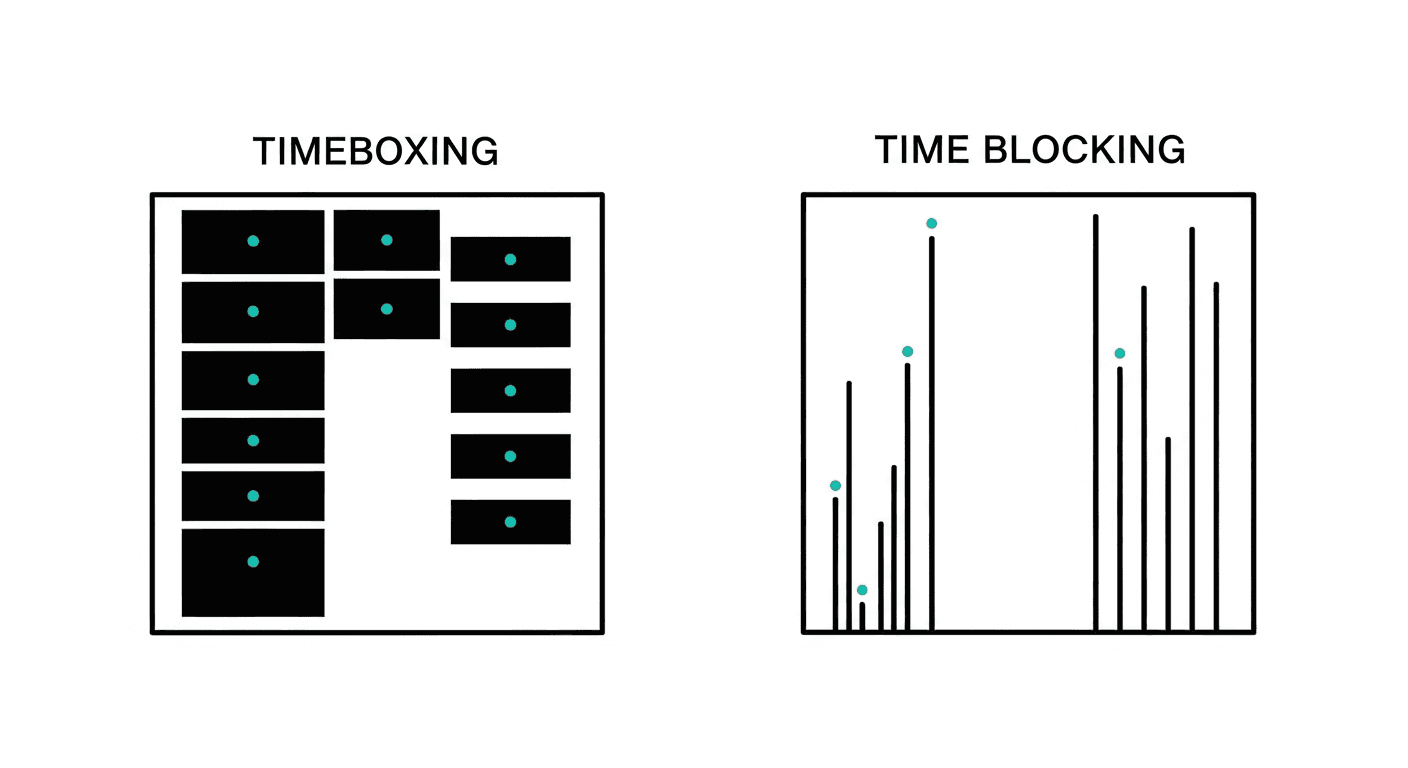
Enter the heavyweights of calendar management: time blocking and timeboxing. While these two terms are frequently tossed around the corporate productivity space as if they are completely interchangeable, they actually represent two fundamentally different approaches to managing your workday. One method protects your focus from the chaos of the outside world, while the other protects your schedule from your own perfectionism. Understanding the nuanced, architectural differences between timeboxing and time blocking—and knowing exactly when to deploy each strategy—is the ultimate differentiator between professionals who confidently dictate their days and those who helplessly let their days dictate them.
The Science
The effectiveness of deliberately structuring your calendar is not just a productivity influencer's talking point; it is backed by substantial, hard data. In an extensive survey of time-management techniques conducted by Harvard Business Review, timeboxing was ranked as the number one most useful productivity tool out of 100 different methods analyzed. The researchers found that professionals who rigorously scheduled their tasks with hard, unmoving deadlines reported a massive increase in their daily output and a significant decrease in end-of-day burnout.
Furthermore, the core distinction between these two methods leans heavily on a well-documented industrial adage known as Parkinson's Law. Coined by Cyril Northcote Parkinson in a 1955 essay for The Economist, the law simply states that "work expands so as to fill the time available for its completion." If you give yourself a full week to write a quarterly report, it will inevitably take a full week to finish. If you give yourself exactly two hours to complete the exact same report, it will take two hours. Timeboxing directly weaponizes Parkinson's Law to your advantage by artificially constraining the time available, forcing efficiency.
Additionally, a landmark study published by the University of California, Irvine, revealed that it takes an average of 23 minutes and 15 seconds to return to an original task after a single interruption. Time blocking directly solves this specific variable by creating walled gardens of time where interruptions are systematically ignored and blocked out entirely. By understanding these two foundational scientific pillars—restricting the expansion of work (Parkinson's Law) and eliminating the massive time loss from workplace interruptions (the UCI study)—we can clearly see why these two specific frameworks are so critical for modern professionals.
The Framework
To truly master your schedule, you must first understand the architectural and mechanical differences between these two methodologies. They may look identical as colored squares on a digital calendar, but their underlying intentions are entirely distinct.
Time Blocking: The Art of Protected Focus Time blocking is the practice of dedicating specific, uninterrupted blocks of time to specific categories of work. You are essentially carving out a defensive perimeter around your attention. When you time block, you are committing to working on a single project or category of tasks for a set duration, but there is no strict expectation that the project will be perfectly completed by the time the block ends.
- Intent: To guarantee that high-priority, important work gets your undivided, uninterrupted attention.
- Flexibility: High. If you do not finish the task by the end of the scheduled block, you simply schedule another block for it tomorrow. The goal is progress, not finality.
- Best Used For: Deep work, creative projects, strategic planning, writing, and complex problem-solving where quality and depth of thought matter far more than speed.
Timeboxing: The Art of Strict Constraint Timeboxing, on the other hand, is an aggressive, offensive strategy. It involves assigning a fixed, non-negotiable maximum unit of time to a task or activity. When the "box" is over, you stop working immediately, regardless of whether the task is completely finished to your ideal standard. It forces completion and ruthlessly attacks perfectionism.
- Intent: To limit the amount of time spent on lower-value tasks and enforce rapid, decisive execution.
- Flexibility: Low. When the timer rings, the work is done and you must move on to the next item.
- Best Used For: Clearing out email inboxes, administrative duties, routine meetings, processing invoices, and drafting initial rough outlines where "done" is significantly better than "perfect."
The Core Difference: Open vs. Closed Loops Think of time blocking as saying, "I will work on the Q3 marketing presentation from 9:00 AM to 11:00 AM." You are dedicating two hours to the process of working. Think of timeboxing as saying, "I have exactly 45 minutes to finalize and submit the Q3 marketing presentation, and I will send whatever I have when the clock runs out." One method focuses entirely on the duration of the effort; the other focuses entirely on the finality of the result.
Practical Application
Knowing the theoretical differences is utterly useless without a practical blueprint for integrating them into your daily routine. The most elite performers do not choose between timeboxing and time blocking; they expertly weave them together to create an impenetrable daily architecture. Here is exactly how you can apply both strategies in the real world starting today.
Scenario 1: Taming the Email Beast (Timeboxing) Most modern professionals keep their email inboxes open all day long, treating them as a continuous, never-ending stream of interruptions. Instead, apply a rigid timebox. Decide that you will spend exactly 30 minutes at 8:30 AM and 30 minutes at 4:30 PM processing emails. Set an actual, physical timer. When the 30 minutes are up, you close the browser tab completely. If you did not get to every single email, the remaining messages must wait until the next designated box. This hard constraint forces you to be incredibly concise in your replies, skip the unnecessary pleasantries, and prioritize the most urgent messages first.
Scenario 2: Executing the Big Project (Time Blocking) You have a massive, career-defining report due at the end of the week. This requires deep, uninterrupted thought. You will create a time block from 9:00 AM to 11:30 AM on Tuesday and Thursday specifically labeled "Report Writing." During these protected blocks, you close all communication applications, put your smartphone in another room, and work solely on the report. You might not finish the report in the first block, and that is perfectly acceptable. The objective was to secure the time to make meaningful, focused progress without the friction of everyday workplace distractions.
Scenario 3: The Hybrid Meeting Strategy Meetings are notorious for expanding beyond their necessary duration—this is Parkinson's Law in action in corporate conference rooms. You can use both concepts here to reclaim your day. First, time block a specific day of the week for all your internal meetings (for example, "Meeting Wednesdays"), which fiercely protects the rest of your week for deep, meaningful work. Then, timebox the meetings themselves. Instead of sending out the default 60-minute calendar invite, timebox the meeting to exactly 20 minutes with a hard, uncompromising stop. You will be amazed at how quickly an agenda is covered and decisions are made when everyone in the room knows the video call is shutting down in exactly 20 minutes.
Scenario 4: Administrative Chores and Micro-Tasks Everyone has a lingering list of tiny, annoying tasks: paying an invoice, booking a flight, filling out an expense report, or updating a spreadsheet. Time block one single hour on Friday afternoon called "Admin Hour." Inside that block, timebox each specific micro-task: 10 minutes for expenses, 15 minutes for travel booking, 5 minutes for the invoice. This prevents the mind-numbing busywork from bleeding into your high-value strategic time earlier in the week.
High-Performer Takeaway
The ultimate insight is that time blocking protects your priorities, while timeboxing prevents your perfectionism. High performers operate on a meticulously crafted schedule that leverages both frameworks simultaneously: they relentlessly block out large, uninterrupted chunks of time for their most critical, needle-moving work, and they aggressively timebox their administrative duties to prevent them from taking over the day.
However, managing a complex calendar of blocks and boxes requires a system that moves at the exact speed of your thoughts. This is where Hello Aria completely transforms how you manage your day. As a Universal Productivity Platform, Aria removes all the friction of managing your schedule and tasks. Imagine you are in the middle of a dedicated time block, reviewing a critical project, and you suddenly realize you need to draft an agenda for tomorrow's team sync. Just message Aria on WhatsApp—"Remind me to draft the meeting agenda tomorrow at 9 AM." The task is instantly captured in Aria's built-in todo list and smart reminders system, and scheduled into your integrated Google Calendar or Microsoft Calendar. No unlocking your phone, no switching between apps, and no breaking your current focus.
Furthermore, when you are in a strict timebox for a fast-paced meeting, Aria's WhatsApp meeting notes feature can automatically generate MoM summaries from your voice notes or group chats. You can then instantly share these action items via Aria's "Circles" for seamless team coordination and automated follow-ups. Everything you need lives on your clear, central dashboard. By utilizing Hello Aria across WhatsApp, Telegram, email, or the web app to handle the rapid capture, scheduling, and follow-ups, you can finally stop managing your productivity tools and start maximizing your time.