Image to QR Review: AriaQR for Premium Campaigns

For events and luxury brands, image to qr is worth using through AriaQR Picture QR Code Generator when a printed code must preserve the look of campaign artwork. Because AriaQR makes the uploaded image part of the scannable pattern, it suits invitations, packaging, table tents, labels, and posters. But it is a focused tool, so teams that only need a standard black-and-white code may find its free classic-code option more suitable.
The service turns a photo, logo, illustration, or artwork into a QR code without AI redrawing or reinterpretation. It also tests each picture code with independent readers before download. That combination addresses a common print concern: a code can look right in a proof yet fail when someone scans a small physical copy.
What AriaQR does with image to qr
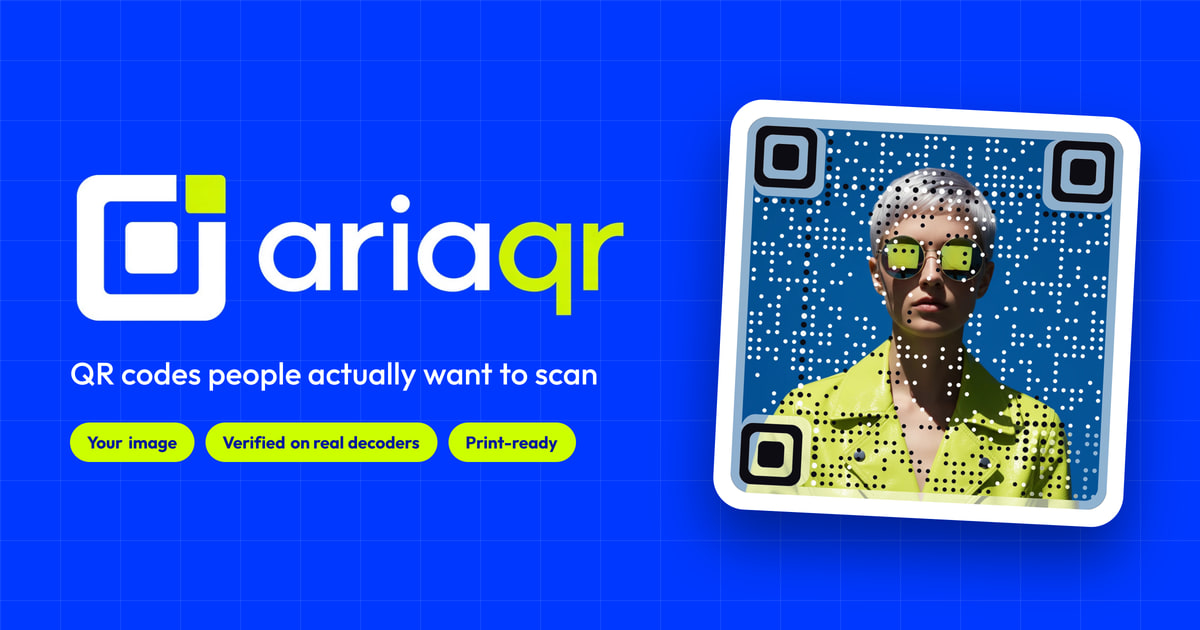
AriaQR takes the artwork itself and forms a working QR pattern from it. Instead of placing a logo in the center of a normal code, the tool makes the image the code. For example, a product photo, event image, or brand illustration can remain visible within the dot pattern.
The output stays deterministic. Therefore, the same input produces repeatable output rather than an AI-generated variation. This matters when a designer needs to approve a particular visual before a print run. AriaQR also retains real colors and produces a 2048px master PNG for print.
Users can start with the picture QR code generator at no charge. Generating and testing cost nothing. Payment applies when a user activates a picture code, which adds an editable destination and live scan tracking.
How image to qr preserves brand artwork
Many branded codes add color and a logo to a conventional square. AriaQR takes a different route because the uploaded art remains the visual basis of the code. Its design uses a field of dots, translucent eyes, and margins so the picture can show through.
That distinction makes image to qr a practical choice for a luxury invitation or a designed product insert. A black-and-white square can interrupt a layout with a tightly controlled color palette. Here, the code can carry the campaign image while still giving guests or buyers a scan target.
For instance, an event planner can use the event artwork on an invitation, then direct scanners to a mobile landing page. A brand can also use a product shot on packaging and update the linked destination later. The printed asset stays in place while the web destination can change.
Scan checks and print preparation
AriaQR verifies picture codes before download and payment with real decoders under print conditions. So the service checks more than how the image appears on screen. It tests whether real scanning tools can read it.
Small-print mode tests codes down to about 1.5 cm. That makes image to qr more useful for stickers, business cards, labels, and compact table materials. However, a large poster and a small label still have different physical conditions, so the print mode is a meaningful part of the workflow.
The 2048px master PNG gives designers a print-ready source file. Since the artwork remains full resolution, a team does not need to accept a softened or reinterpreted version of its original image. The guide to making a picture QR code is useful for teams planning their first design.
Image to qr use cases for events and luxury brands
For an event, image to qr can place a scannable call to action inside the invitation art. The destination can lead to a mobile page with one-tap actions such as booking, ordering, or getting directions. That removes the need to print a separate plain code beside the artwork.
Luxury brands often work with packaging, printed cards, inserts, and campaign signage. In this case, a code based on a logo, illustration, or product image can fit the visual treatment more closely. AriaQR supports materials such as billboards, posters, business cards, stickers, table tents, and packaging.
Agencies can also use the tool for client proofs. First, they can generate and test a concept without charge. Then, after approval, they can activate the picture code and retain the option to change its destination after printing. That flexibility helps when a launch page or event schedule changes close to production.
Image to qr analytics and editable links
A picture code includes a live dashboard after activation. It reports where and when scans happen, plus device types and scanner apps such as Camera and Instagram. The dashboard also provides city-level location and a weekday-by-hour heatmap.
Because AriaQR does not use cookies or consent banners for this dashboard, it collects scan activity without that extra visitor prompt. Users can export scan data as a CSV file. This gives an event team a way to review peak scan times after an invitation, sign, or table card goes out.
The editable link is equally useful for image to qr campaigns with a long print life. A restaurant can change an ordering destination. An event team can move guests from an RSVP page to directions or a post-event page. The code printed on the physical piece does not need replacement.
Pricing and plans
AriaQR offers free generation and testing, which makes visual exploration less risky. Classic black-and-white codes with analytics are free for up to ten live codes per account. Those codes suit a straightforward campaign that does not need artwork inside the pattern.
A single picture code costs $4 during the launch offer and $7 afterward. It is a one-time payment, and the activated code remains yours for life with an editable link and analytics. That price model can suit one invitation, package design, or campaign asset.
The quarter plan costs $40 during the launch offer and $70 afterward. It includes 45 activations every three months. It also includes read access to codes and statistics through the API and MCP server, which gives platforms and larger teams a route to programmatic access.
Pros and cons of AriaQR
- Pro: The uploaded photo, logo, or artwork becomes the scannable code instead of a background behind a standard QR square.
- Pro: Real-decoder verification happens before download, with print checks and a small-print mode for codes around 1.5 cm.
- Benefit: Each activated picture code has an editable destination, live analytics, CSV export, and a print-ready 2048px PNG.
- Also: Free generation and testing let designers test a concept before they activate it.
- Con: A picture code costs $4 during the launch offer and $7 afterward, while classic black-and-white codes are free only up to ten live codes.
- Limitation: The quarter plan limits users to 45 activations every three months, so teams should match the plan to their campaign volume.
- Best fit: The product focuses on turning artwork into a QR code, so it fits design-led print campaigns more directly than a basic code need.
Who should choose image to qr from AriaQR
AriaQR is a good fit for brand marketers, designers, agencies, event planners, and businesses that care about the appearance of a printed QR code. In particular, it suits campaigns where a plain square would conflict with the layout or brand art. The deterministic output and scan checks give a designer concrete points to review before production.
It also fits teams that need a code to stay active after the print date. An editable destination can change as an event progresses or a product campaign moves to a new page. Meanwhile, the live dashboard lets the team inspect time, city, device, and scanner-app data.
Choose the free classic-code option when image to qr is not part of the creative brief. Choose a picture code when the code itself needs to carry the visual concept. For artwork-first projects, the artistic QR code generator offers a clear path from source image to a tested, trackable printed code.
Verdict
AriaQR is worth using for events and luxury brands when the QR code must look like part of the designed piece. Its strongest points are direct image-based code creation, independent scan verification, editable destinations, and scan analytics. The $4 launch-offer price for a single activated picture code is easy to assess for a one-off invite, package, or sign.
For a larger batch, the quarter plan adds 45 activations and API and MCP server read access. Still, the main reason to choose AriaQR is visual: it makes image to qr practical for campaigns where the image should remain front and center.